
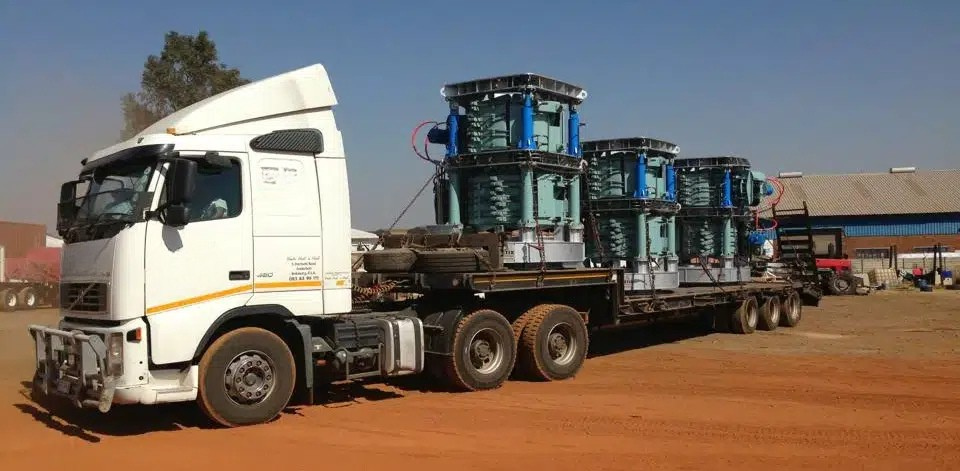
Transporting abnormal loads in South Africa—and across its borders into neighbouring African countries—is a highly regulated and specialised operation. Whether it’s earthmoving equipment, mining machinery, or massive industrial components, these loads fall outside standard vehicle dimension or weight limits and require special handling, documentation, escort vehicles, and routing.
These are the questions we will answer in this article.
- What qualifies as an abnormal load?
- Legal dimensions and weight thresholds?
- Permits required?
- Restrictions on movement times and routes?
- Escort vehicle requirements?
- And what you need to know before moving an abnormal load.
What Is an Abnormal Load?
An abnormal load is any load that exceeds the legal limits set out by the National Road Traffic Act of South Africa for standard vehicle dimensions or mass.
A load is classified as abnormal if it exceeds:
Width: More than 2.6 metres
Height: More than 4.3 metres (measured from the ground)
Length: More than 22 metres for an articulated vehicle (including the load)
Weight: More than 56 tonnes gross vehicle mass (GVM) for normal road freight
These figures can vary slightly depending on the route and province, but as a general rule, any vehicle or combination exceeding the above requires abnormal load classification and a special permit.
Common Examples of Abnormal Loads
At Lowbeds South Africa, we transport a wide range of abnormal loads, including:
- Earthmoving equipment (excavators, bulldozers, graders)
- Large mobile cranes
- Mining machinery and processing plants
- Steel structures and prefabricated buildings
- Oversized tanks and silos
Types of Trailers Used for Abnormal Loads
Transporting abnormal loads requires specialized trailers tailored to the size and weight of the load. We typically use:
Lowbed Trailers: Ideal for heavy machinery. Lower deck height allows for taller cargo.
Extendable Trailers: Used for extra-long loads like beams or blades.
Step-Deck Trailers: Accommodates tall loads while keeping within height restrictions.
Multi-Axle Modular Trailers: For ultra-heavy and complex loads, often used in mining or construction.
These trailers distribute weight evenly and reduce the impact on road surfaces and infrastructure.
Abnormal Load Permit Requirements
Permits are compulsory for abnormal load transport in South Africa. Issued by the Road Traffic Management Corporation (RTMC) and provincial roads authorities, permits specify:
- The approved route
- The type of load
- Vehicle and trailer configuration
- Axle weights
- Travel time and date
- Escort requirements
- The process includes
- Application submission with all vehicle and load details
- Route approval based on bridge clearances, road capacity, and conditions
- Permit fee payment
- Issuance of a time-bound, route-specific permit
Permits can take up to 7 working days to be processed, especially for larger or cross-border loads.

Cross-Border Abnormal Load Transport
When moving loads into neighbouring countries like Botswana, Namibia, Mozambique, Zimbabwe, Zambia, or DRC, the following applies:
- Separate abnormal load permits are required from each country’s roads authority
- Transit customs documentation, such as SADCs, are needed
- Border escort and inspection protocols must be followed
- Routes may need to be pre-approved by both South African and destination country authorities
We handle the logistics, permits, and border procedures to make cross-border heavy transport stress-free for our clients.
Movement Restrictions: Days, Times & Routes
To ensure safety and minimise disruption to normal traffic, abnormal load transport in South Africa is subject to movement restrictions.
Days & Times
No travel at night, movement generally allowed from sunrise to sunset only
No movement on weekends or public holidays (unless approved)
Some provinces allow limited movement on Saturdays until noon
Route Restrictions
Only designated or approved routes may be used
Bypasses and alternative routes may be mandated to avoid low bridges, weak road surfaces, or dense urban areas
Movement may be restricted during rush hours in major cities like Johannesburg, Durban, or Cape Town
Escort Vehicle Requirements
For safety and compliance, abnormal loads require escort vehicles, also known as pilot cars, depending on size and classification.
Escort Requirements by Width
- 2.6–3.0 metres: No escort (but requires permit)
- 3.0–3.5 metres: 1 front escort
- 3.5–4.5 metres: 2 escorts (front and rear)
- Above 4.5 metres: 2 escorts + Traffic Police escort may be required
Other escort requirements:
- High loads (over 4.6 m): Route must be surveyed for overhead obstacles
- Extra-long loads: May need rear steer and multiple escorts
- Bridge and road engineers may need to inspect and approve the route for ultra-heavy loads
Each escort vehicle must be
- Marked clearly with “Escort Vehicle” signs
- Equipped with amber flashing lights
- Operated by trained and licensed drivers
Risks and Why Proper Planning Is Essential
Abnormal load transport carries significant risk, including:
- Road damage and bridge stress
- Traffic disruptions
- Overhead cable or infrastructure collisions
- Delays at border crossings
- Safety risks in built-up areas
Proper route planning, surveying, permitting, and coordination with local authorities is essential to mitigate these risks.
At Lowbeds South Africa, we manage this entire process for you—safely, legally, and efficiently.
Abnormal Load Guidelines
- Width – Up to 2.6 m – Permit required over 2.6 m
- Height – Up to 4.3 m – Permit required over 4.3 m
- Length – Up to 22 m (articulated) – Permit required over 22 m
- Gross Vehicle Mass (GVM) – Up to 56 tons – Permit required over 56 tons
At Lowbeds SA, we have decades of experience moving abnormal loads throughout South Africa and into the rest of Africa. Our fleet includes modern, fully-equipped lowbed trailers, experienced drivers, certified escort vehicles, and an expert permit and logistics team.
We take care of
- All permitting and paperwork
- Route surveys and planning
- Cross-border documentation
- Escort coordination
- Insurance and compliance
What’s the Difference Between a Lowbed and a Step Deck Trailer?
When it comes to moving heavy and oversized equipment, choosing the right trailer is key. At Lowbeds.co.za, our fleet includes trailers with capacities ranging from 20 tons to 75 tons, and two of the most commonly used trailer types are lowbeds and step decks.
Lowbed Trailers (Also called Low-Loaders)
Deck Height: The deck is extremely low to the ground, often just 800–1,200 mm in height.
Loading Height: Because of the low deck, taller equipment (like excavators, bulldozers, or crushers) can be transported without exceeding height restrictions.
Heavy Duty: Ideal for very heavy or tall machinery, often used in construction and mining.
Carrying Capacity: At Lowbeds.co.za, our lowbed trailers handle loads up to 75 tons.
Ease of Loading: Machinery can be driven or winched onto the trailer from the rear using hydraulic ramps.
Lowbeds are best for
- Earthmoving equipment transport
- Industrial machinery
- Mining gear
- Abnormal height or weight loads
Step Deck Trailers (Also called Drop-Deck Trailers)
Deck Design: Has two levels – a lower main deck and a raised front deck (gooseneck area).
Slightly Higher Deck Height: The lower deck is higher than a lowbed, typically 1,000–1,400 mm off the ground.
Versatility: Step decks can handle a wide range of cargo and are ideal when the load is slightly oversized but doesn’t require a full lowbed.
Carrying Capacity: Typically up to 20–40 tons, depending on configuration.
Height Clearance: Can carry taller equipment than a flatbed, but not as tall as what a lowbed can handle.
Step deck trailers are best for
- Medium-weight equipment
- Containers and skids
- Tractors and farming machinery
- Palletized freight that exceeds flatbed height limits
Not Sure Which Trailer You Need?
If you’re unsure whether your load needs a lowbed or a step deck, our team can help. We’ll assess the:
- Dimensions and weight of your equipment
- Route restrictions
- Permit requirements
- And loading options
With trailers ranging from 20 to 75 tons, we can match your load to the right trailer every time.